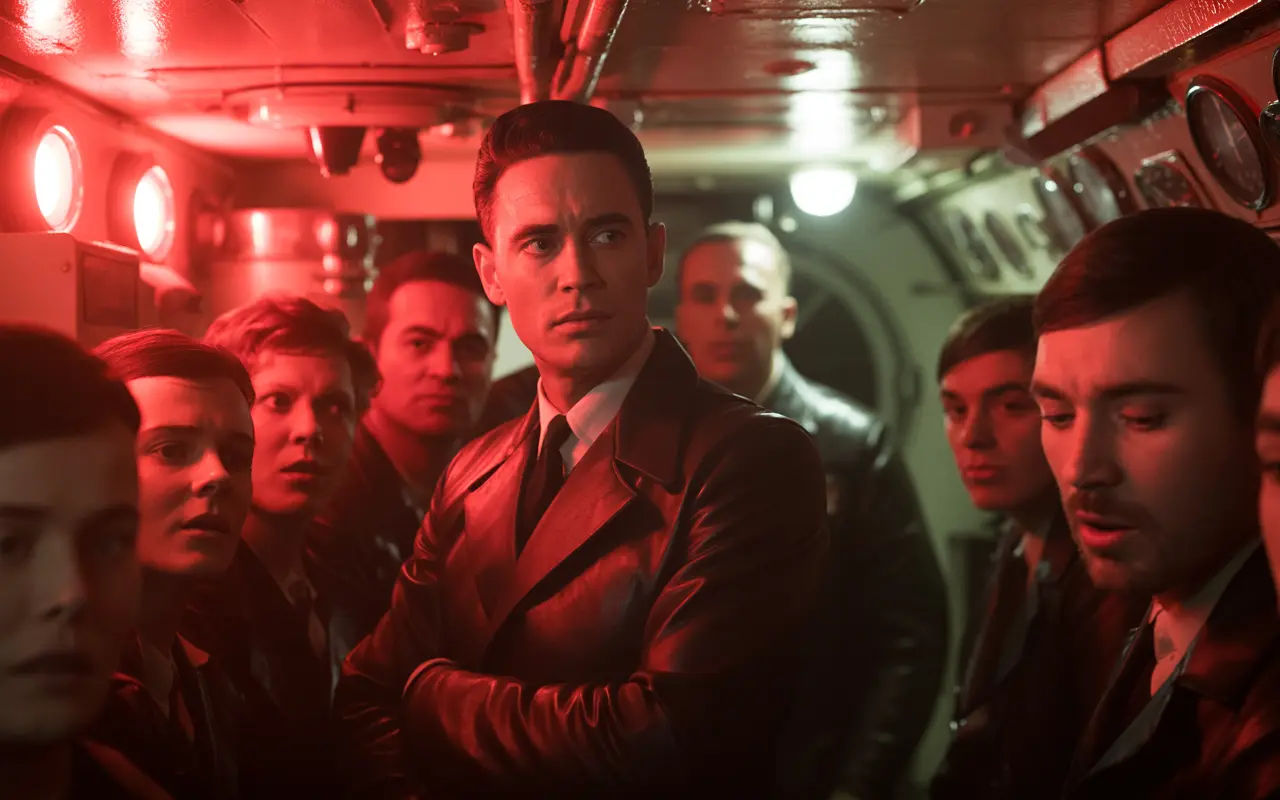
Most heroes are remembered with medals, parades, and history books that celebrate their courage. But some of the greatest heroes remain hidden, their stories buried under decades of secrecy, politics, and silence. Vasili Arkhipov was one of them.
A quiet Soviet naval officer, a man who never asked to be a symbol—yet on a single day in 1962, deep under the Caribbean Sea, he made a decision that prevented a nuclear war and possibly the end of human civilization.
This is not just a story about a military officer.
It is the story of a man who carried an impossible weight, who stood between the world and destruction, and who chose caution, humanity, and reason when panic whispered otherwise.
A Childhood Shaped by War and Scarcity
Vasili Aleksandrovich Arkhipov was born in 1926 in a small village near Moscow. His childhood was not filled with comfort or certainty; it was marked by poverty and the looming threat of war. He grew up during Stalin’s Soviet Union, where silence was a survival skill and obedience was deeply ingrained.
When World War II erupted, it shaped him in ways he never openly spoke of. As a teenager, Vasili witnessed the devastation of his homeland—the starvation, the fear, the uncertainty. Perhaps this is where it began: his belief that war was a last resort, not a first solution.
But like many young men of his generation, he answered the call to serve. He joined the Soviet Navy, where discipline was strict, conditions were harsh, and the margin for error was razor-thin. But it was also a place where his calmness and reliability set him apart.
Aboard the K-19: A Man Forged in Crisis
Before the incident that would define him, Vasili survived another catastrophe—one that would foreshadow his future.
In 1961, he served as the deputy commander on the Soviet submarine K-19, later nicknamed “Hiroshima” because of the disasters associated with it. During a mission in the North Atlantic, a reactor cooling system failed, threatening a meltdown.
The crew had to improvise repairs using makeshift pipes and no protective gear. Many of the sailors who volunteered to fix the reactor died painfully from radiation exposure within weeks. Vasili himself was exposed, too, and became seriously ill.
He saw comrades sacrifice themselves. He saw panic. He saw what happens when systems fail and human lives become collateral damage.
Those memories remained etched in him.
He knew exactly what nuclear death looked like—not hypothetically, but in the flesh.
This experience mattered more than anyone realized at the time. Because one year later, it would be the difference between catastrophe and survival.
October 1962: A World on the Edge
The Cuban Missile Crisis was the most dangerous moment in human history. The United States and the Soviet Union were locked in a deadly standoff. President John F. Kennedy and Premier Nikita Khrushchev were playing nuclear chess, each move escalating the risk.
Underwater, unknown to the world, was Soviet submarine B-59, carrying a secret: a nuclear torpedo powerful enough to vaporize a fleet—and trigger global nuclear war.
On board that submarine was Vasili Arkhipov.
Life in the Metal Coffin
For several days, B-59 had been submerged too long. Without access to fresh air, the submarine became a hellish furnace. The temperature rose above 45°C (113°F). Sweat dripped from the ceiling. The air was stale, suffocating.
Men fainted from heat. Others hallucinated. Sleep was impossible.
Then came the U.S. Navy.
American ships, desperate to signal the submarine to surface, began dropping practice depth charges—small explosives meant as warnings. But to the exhausted Soviet crew, they felt like attacks.
Inside B-59, the crew believed war had already begun.
Isolated from communication, battered by explosions, and living in unbearable heat, emotions shifted from fear… to anger… to desperation.
The Decision That Should Never Have Existed
On Soviet submarines armed with nuclear weapons, the rule was simple:
Three officers must unanimously agree to launch.
Most submarines required only the captain and political officer.
But B-59 had a third vote: Vasili Arkhipov, the overall flotilla commander.
When another round of explosions shook the submarine, Captain Savitsky snapped.
Convinced war had started, he shouted:
“We’re going to blast them now! We’ll die, but we’ll sink them all. We won’t disgrace our navy!”
The political officer agreed.
Two votes for launch.
One vote left.
All eyes turned to Arkhipov.
Imagine this moment:
- Heat pressing on your skull
- Crew members collapsing
- No information from Moscow
- Depth charges exploding outside
- A nuclear weapon ready, waiting
The world hung on a single man’s voice.
The Silence Before “No”
Vasili did not shout.
He did not panic.
He did not crumble under pressure.
He argued. He reasoned. He demanded calm.
He insisted that they surface, establish contact, and confirm the situation.
Voices rose. Tempers flared. Men were shaking, trembling, exhausted. The captain was furious—accusing Vasili of cowardice, hesitation, betrayal.
But Vasili stood firm.
Perhaps it was what he had seen in K-19.
Perhaps it was the memory of his dying comrades.
Perhaps it was simply his nature: rational, steady, unwilling to unleash irreversible destruction.
After a long, agonizing confrontation, the captain gave in.
They did not launch the torpedo.
They surfaced instead.
Above the waves, the Americans watched the exhausted submarine rise.
They had no idea how close the world had come to annihilation.
The World Was Saved, but No One Knew
The crisis ended.
Humanity exhaled.
But Vasili Arkhipov received:
- No medals
- No honors
- No public recognition
The incident was classified.
He went home to a tiny apartment in Moscow.
He returned to a quiet life with his wife, Olga, and never boasted about what he had prevented.
Olga later recalled:
“He simply did his duty, as he saw it. He never thought of himself as a hero.”
He died in 1998 from complications likely linked to earlier radiation exposure.
He never knew that decades later, outside the secrecy of the Cold War, the world would finally learn the truth.
Why Vasili Matters More Than Ever
Historians estimate that a nuclear launch from B-59 would have forced the United States to retaliate.
NATO would have followed.
The Soviet Union would have struck back.
Tens of millions would have died in hours.
Civilization might not have survived.
And all of it was prevented by one man, sweating in the dark, choosing calm over chaos.
Today, Arkhipov is recognized globally as:
“The man who saved the world.”
But in truth, he saved far more than that.
He saved:
- families never torn apart
- cities never vaporized
- futures never stolen
- generations who never knew how close they came to living in ruins
His heroism wasn’t loud.
It wasn’t celebrated.
It wasn’t even known.
It was quiet, resolute, and deeply human.
Sometimes the greatest courage is simply saying no.