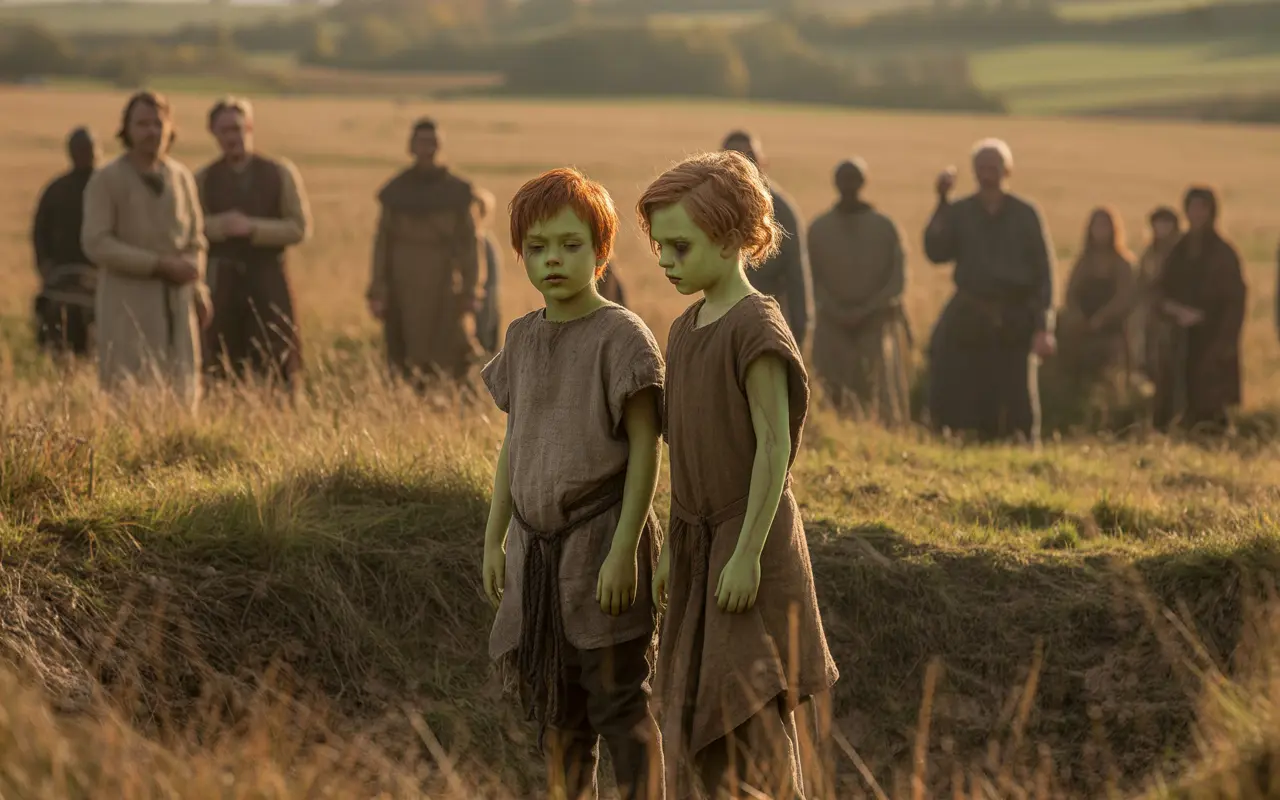
No one in the quiet English village of Woolpit expected their lives to change on that warm autumn day. Life in the 12th century was predictable and hard: fields to tend, animals to feed, prayers to say. People kept to routines, because routines kept fear away — fear of poor harvests, outbreaks of illness, or the unknown forces they believed lived in the woods.
But then two children appeared at the edge of a wolf pit — and nothing about them seemed familiar.
A Discovery That Should Have Been Impossible
The story begins near a field, when harvesters heard strange rustling near the deep pits dug to trap wolves. At first, they assumed an animal fell in again. But as they approached, they heard something else — whispers, soft and fearful. Voices. Children’s voices. Speaking… something unrecognizable.
And then the harvesters saw them.
A boy and a girl, clutching each other so tightly their knuckles turned pale green — as green as the rest of their skin.
The villagers froze. The children’s clothes were made of some unfamiliar fabric, rough but vibrant, dyed in strange colors no local weaver used. Their eyes were wide, overwhelmed, frightened. The girl trembled; the boy hid his face in her shoulder.
The harvesters called out to them, but the children shrank back, speaking quickly in a language that didn’t resemble English, French, or anything they had ever heard. Their words curled like leaves in the wind — soft, melodic, but utterly foreign.
And yet, despite their fear, the children stepped forward when offered a hand.
Something about the villagers — or perhaps their desperation — pushed them to trust.
A Village Caught Between Fear and Curiosity
Woolpit was a place where superstition lived side by side with faith. Green children appearing from nowhere?
Some whispered it was witchcraft. Others said they were fairies, or spirits, or omens of misfortune.
But the lord of the manor, Sir Richard de Calne, ordered that the children be brought to him. He believed in reason — or at least, he believed mysteries should be studied, not feared.
The children were brought inside his estate, and the villagers watched, half expecting them to vanish like mist.
Instead, the children huddled together on the floor, exhausted and hungry.
Food was brought: bread, apples, roasted meat. But they pushed everything away, crying, shaking their heads. The girl tried a piece of bread and spat it out instantly, terrified.
Days passed, and they still refused to eat, becoming weaker and weaker. None of the villagers understood. Some feared they were starving themselves because they were not human.
But then came the moment that changed everything.
A servant entered the room holding a bundle of freshly picked broad beans — still in their green pods.
The children’s eyes widened.
They rushed forward, trying to open the pods the wrong way, struggling until someone showed them how. And then they ate — hungrily, desperately, as though they had been waiting for this food all their lives.
The villagers exchanged looks.
Human or not, these children were starving just like anyone else.
Learning to Live in a World Not Their Own
Slowly, the children began to grow stronger. They learned to communicate with gestures. The girl became more trusting; the boy remained quiet, shy, clinging to her as though she were the only familiar thing left in his world.
It took months for them to learn enough English to speak, and even then, their accents were strange, their words carefully chosen.
They said they came from a place they called St. Martin’s Land — a place where everything was green. The sky was dim, the sun never shone brightly, and the people all had green skin, just like them. They lived underground or in deep valleys, separated from the world by a great river.
They said they were watching their father’s flock when they followed the sound of distant bells — a sound that does not exist in their world. They walked toward the echo until everything suddenly changed. A bright light surrounded them. When it faded, they were near the wolf pits, terrified and lost.
Most villagers believed they wandered from a foreign land and invented a fantastical story to explain the trauma. But others whispered that the children crossed from another realm — a place between heaven and earth, where the light never fully reached.
Tragedy Strikes
Though both children eventually adjusted, tragedy came too soon.
The boy fell ill during the winter.
He grew pale — not green, but grey. The physicians had no idea what was wrong. Perhaps the change of food, the change of world, or the overwhelming homesickness finally took its toll. He grew weaker until one night he slipped away quietly, leaving the girl alone in a world that had never been hers.
She cried for days, refusing food, refusing to speak. Sir Richard sat with her, trying to comfort her despite not understanding her grief.
The loss of her brother changed her. She grew more serious, more introspective. The villagers said she carried sadness in her eyes, a longing for a place no one else could imagine.
A New Life — But Never a Complete One
Over time, the girl — now known as Agnes — adapted fully to Woolpit. Her green tint faded gradually, until her skin looked like that of any other child. She learned English fluently, helped in the manor, and even laughed again.
But she never forgot where she came from.
When she was old enough, she worked for Sir Richard’s household and eventually married a man from King’s Lynn. She built a life. She found her place. And yet, even as she aged, she never stopped telling her story — not to frighten, but as a reminder of wonder. Of mystery. Of worlds just beyond reach.
She described her homeland whenever asked:
A dim world, separated by a great chasm.
A land where twilight reigned.
A place where she once belonged… but could never return to.
Some believed her wholeheartedly.
Some dismissed her as delusional.
Some feared her story as a sign of witchcraft.
But Agnes never wavered in her truth.
A Legend That Refuses to Die
Centuries later, the mystery of the Green Children of Woolpit remains unsolved. Historians propose explanations:
– a strange illness causing greenish skin pigmentation
– malnutrition
– refugees from an unfamiliar land
– children hiding from war
– psychological trauma
– mass misunderstanding
And yet none of these theories explain the language, the clothing, or how two children could appear in a place they had never seen before with no path leading to Woolpit.
Some say the children were from a lost European community.
Others insist they crossed the boundary between worlds — a rare moment when two realities brushed against each other long enough for two frightened children to slip through.
Whatever the truth, the legend endures because it touches a universal feeling:
The fear of the unknown —
and the hope that magic might still exist.