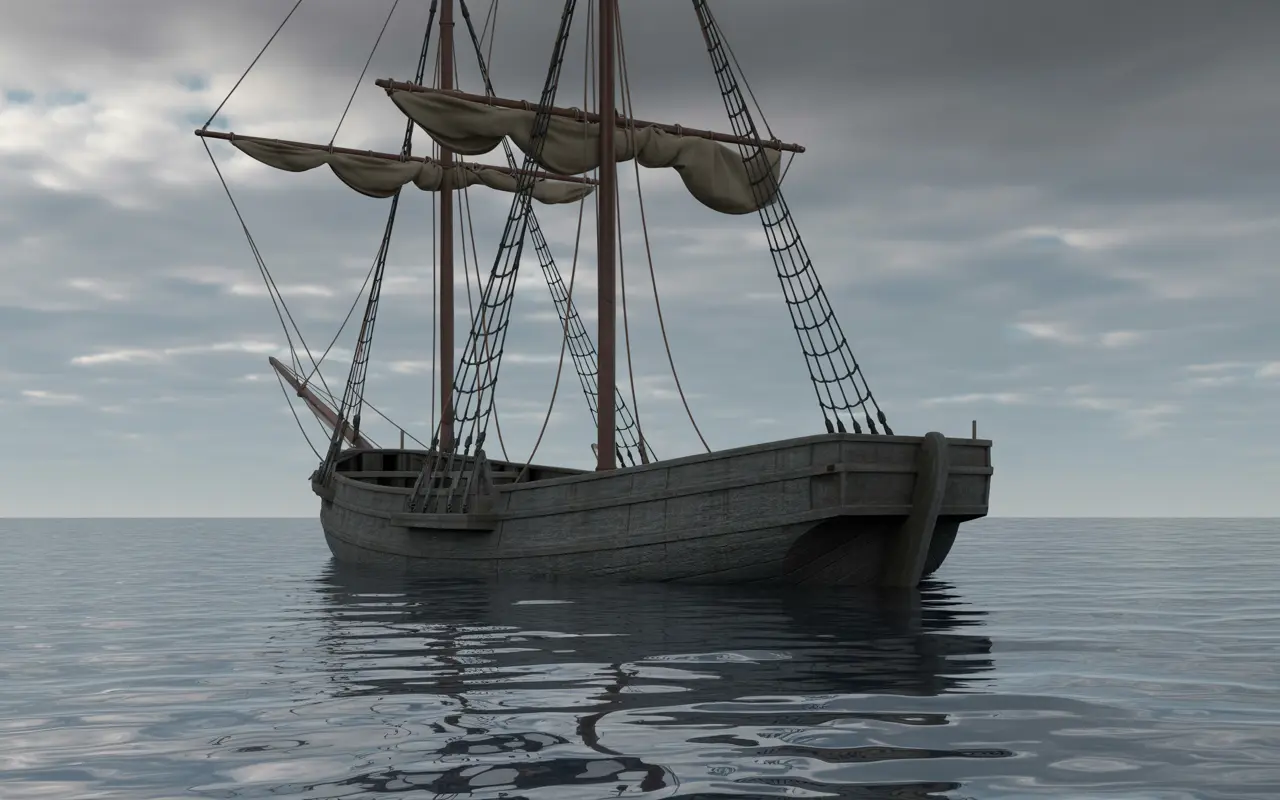
On a cold December morning in 1872, the sea lay strangely calm in the middle of the Atlantic. The sun was still low, staining the horizon with a pale winter light. Waves rolled gently, almost shyly, as if the ocean itself was holding its breath. Far out on those quiet waters, a ship drifted alone, its sails partly set, its course steady—but something about it felt wrong. That ship was the Mary Celeste. And by the time another crew spotted her, she had already become the most enduring maritime mystery in history.
The story of the Mary Celeste is not only about an empty ship.
It’s about fear and courage, family and duty, and the thin, fragile line that separates everyday life from the unknown. It is a story of a captain who sailed with his wife and little daughter, of a crew who trusted him, and of a disappearance so perfect and silent that even today—over 150 years later—we are no closer to understanding what truly happened.
A Captain Driven by Responsibility – Benjamin Briggs
Captain Benjamin Spooner Briggs was not the kind of man who made reckless decisions. Born into a respected seafaring family in Massachusetts, he had earned a reputation as a calm, thoughtful, deeply moral man. Those who knew him described him as steady as an oak, the kind of captain whose presence alone eased the worries of rough seas.
Briggs loved two things in his life more than the ocean:
his wife Sarah and his two-year-old daughter Sophia.
In 1872, when the Mary Celeste prepared to sail from New York to Genoa with a cargo of industrial alcohol, Briggs made a rare choice—he took his family with him. He believed the journey would be safe, perhaps even restful. It was a chance for them to stay close, to turn months apart into months together.
Before leaving port, Briggs wrote letters filled with gentle optimism.
He spoke of calm weather, of hopes for smooth sailing, of how happy he felt to have his wife and daughter on board. There was no shadow, no omen, nothing to hint at the darkness waiting ahead.
A Ship with No Voice
The Mary Celeste wasn’t a troubled ship. She had been recently refitted, her hull strong, her supplies abundant. Her cargo was stored properly. Her crew, though small, was experienced and loyal.
On the morning of November 7, 1872, the ship set off.
Then—nothing. No distress call. No sightings. No messages. For a month, the vast ocean swallowed every trace of her journey.
The Moment of Discovery
On December 4, 1872, the British ship Dei Gratia spotted a vessel drifting strangely, her course erratic but controlled by the wind. The sails were torn in places, but not badly enough to suggest a major storm. The ship seemed almost shy, as if it wished not to be noticed.
Captain David Morehouse, who knew Briggs personally, felt an immediate chill. “Something is wrong,” he muttered to his first mate. He ordered a boarding party.
What they found became legend.
An Empty Ship… Yet Untouched
The boarding crew climbed onto the Mary Celeste expecting the worst—bodies, perhaps a struggle. Instead, they stepped into a ghost world.
The ship was silent.
No footsteps.
No voices.
No movement.
Below deck, the air was still.
But what terrified them most was not what they found.
It was what they didn’t.
Food on the table.
Literally—meals left as if the crew had expected to return at any moment.
The cargo was intact.
Nothing was stolen.
No signs of violence.
No blood, no damage, no struggle.
The crew’s belongings remained.
Pipes, boots, clothes—all carefully stored.
A missing lifeboat.
Only one thing was gone: the small ship’s boat, just big enough to carry the crew.
It was as if everyone had calmly stepped off the ship… and vanished into the horizon.
The Captain’s Log – A Gentle Storm, Nothing More
In the captain’s logbook, the last entry was dated ten days before the discovery. It described mild weather, nothing alarming. The ship had been slightly off course, but safe.
So why would Briggs—who valued safety above all—abandon his ship, wife, daughter, and crew for a lifeboat on the open ocean?
It made no sense.
The Ghostly Details That Deepened the Mystery
As investigators examined the ship, more unsettling clues emerged:
1. A deep cut on the bow
Not enough to be dangerous—more like a scrape from something floating.
2. A missing chronometer and sextant
These were essential navigation tools. Taken intentionally. But for what? Escape? Evacuation?
3. Water in the bilges
Not dangerous levels. But enough to make an inexperienced captain nervous. And Briggs was not inexperienced.
4. The ship was seaworthy
Very much so. In fact, she sailed to port under her own power after being towed.
Everything pointed to one conclusion:
The crew left the ship voluntarily—but the reason remains a black hole.
Theories—Each More Haunting Than the Last
Over the years, thousands of theories have tried to explain the inexplicable.
1. A sudden waterspout
A huge column of ocean water hitting the ship might have terrified the crew into thinking she was sinking.
2. Fumes from the alcohol cargo
Some believed the barrels leaked, filling the hold with explosive vapors. Briggs may have ordered everyone into the lifeboat temporarily—planning to return.
But the lifeboat’s rope might have snapped.
3. Pirates
But nothing was stolen.
4. Mutiny
But no sign of violence.
5. Seaquake
A strong underwater tremor could shake a ship violently without leaving visible damage.
6. Religious panic or mass hysteria
People of that era were deeply superstitious. A strange phenomenon—a sudden sound, a light, a wave—could trigger a devastating chain reaction.
7. Something… unexplainable
A story too eerie to dismiss whispers that something came aboard—something terrifying enough to make everyone flee instantly.
But the truth?
The truth is that nobody knows.
The ocean holds its secrets, and the Mary Celeste became one of them.
A Family Lost Beyond Imagination
Perhaps the most heartbreaking part of the story is not the mystery.
It is the human cost.
Benjamin Briggs.
His gentle wife, Sarah.
Their bright-eyed daughter, Sophia.
The entire crew—fathers, sons, brothers.
No wreckage of the lifeboat was ever found.
No bodies.
No personal items washed up on a distant shore.
It was as if the sea swallowed them whole, leaving behind only their ship—silent, drifting, waiting for someone to tell its story.
To this day, when sailors pass through that part of the Atlantic, some swear they feel a chill, as if the air grows heavier, as if unseen eyes watch from the waves.
And they whisper:
Mary Celeste.
Why This Mystery Endures
The Mary Celeste is a perfect storm of the unknown—real enough to be chilling, human enough to be heartbreaking.
We know these people existed.
We know they laughed, cooked meals, watched the sun set on the ocean, cared for a little girl toddling around the deck.
We know something happened that ruptured that fragile peace.
But what?
That question has echoed for more than a century and a half.
It’s the space between what we know and what we fear that keeps the Mary Celeste alive.
Because mysteries don’t die.
They drift—like abandoned ships—through time.