The story of the Princes in the Tower is one of the most enduring mysteries of English history—a knot of ambition, innocence, power, betrayal, and silence woven together in a way that still unsettles people more than five hundred years later. It is a story that begins with promise, then plunges into darkness, leaving behind nothing but theories, whispered accusations, and the ache of two children whose fate was erased.
But before the boys disappeared, they were very real. They laughed. They dreamed. They trusted people they shouldn’t have. And England waited for a king who would never come.
A Kingdom on the Edge
The year was 1483. England had suffered decades of turmoil known as the Wars of the Roses, a tangled conflict between two branches of the royal family: the House of York and the House of Lancaster. When King Edward IV—strong, charismatic, and politically gifted—died suddenly in April, the nation collectively held its breath.
His heir, Prince Edward, was only twelve.
His younger brother, Prince Richard, was nine.
Two boys, raised with royal privilege but also with the weight of expectation, were pushed overnight into the heart of a political storm.
Queen Elizabeth Woodville, their mother, felt the danger instantly. She had lived through years of bloodshed. She knew that a child king could easily become a puppet—or a target. She gathered her daughters and her youngest son and fled into sanctuary at Westminster Abbey, where the Church could protect them. But she had no choice: she had to let Prince Edward travel toward London to prepare for his coronation.
She hoped—foolishly or not—that the kingdom would respect her husband’s last wish: for his loyal brother Richard, Duke of Gloucester, to act as Protector until young Edward was old enough to rule.
Hope, however, can be a fragile shield against ambition.
A Protector With His Own Plans
Richard, Duke of Gloucester, arrived with courtesy and politeness—and an army. He insisted he was only protecting the young king, but his actions told another story. He arrested the Woodville relatives traveling with Prince Edward, accusing them of treason. Then, instead of bringing Edward directly to the royal palace, he brought him to the Tower of London.
This might sound sinister today, but the Tower was a royal residence as well as a prison. Kings stayed there before coronation. Richard could claim it was tradition.
But the walls felt heavy. And the gates shut with an echo that made courtiers whisper.
Queen Elizabeth, still in sanctuary, felt the chills of history creeping toward her sons. But she was trapped. If she tried to leave, she risked arrest. If she stayed, she couldn’t protect her boys.
And then came the blow that broke her: Richard demanded that the younger prince, Richard of Shrewsbury, be brought to his older brother “for his comfort.”
Comfort. A gentle word that masked a darker intent.
After days of pressure, Elizabeth surrendered her nine-year-old son. Witnesses say she cried as she kissed him goodbye, knowing she might never see him again.
She was right.
Two Princes Behind Stone Walls
The boys were reunited in the Tower, and at first, things seemed normal. They played, walked in the gardens, laughed with their attendants. People saw them at the windows. They looked like what they were—children waiting for the future to begin.
But then, the sightings grew rare.
Richard, the Protector, took more control of the kingdom. He declared the marriage of Edward IV invalid and the princes illegitimate. Parliament agreed. Suddenly, the two boys who were the rightful heirs were legally erased.
And Richard crowned himself King Richard III.
Days later, the princes vanished from public view entirely.
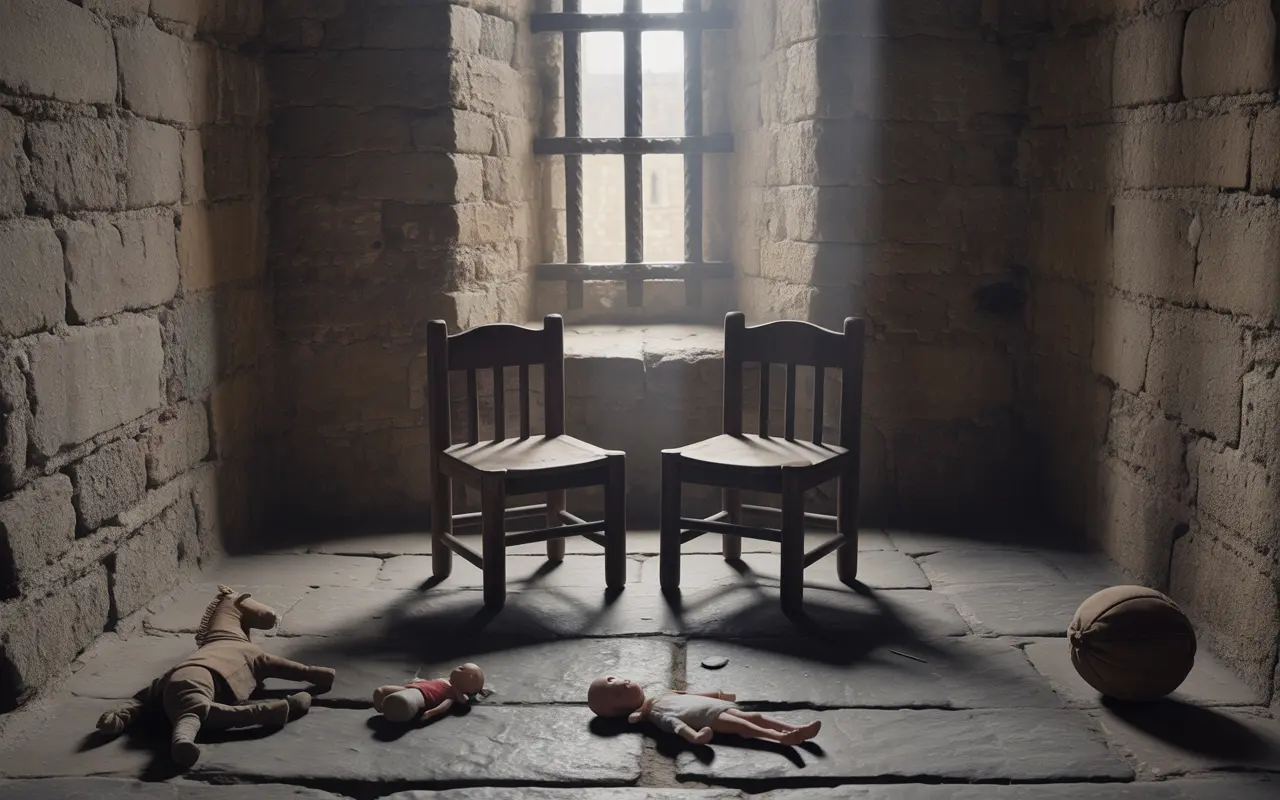
Attendants were dismissed. Access to the Tower was restricted. The boys’ rooms emptied, their toys left untouched. The windows went still.
Rumors spread faster than the plague. Some whispered they were sick. Some whispered they’d been moved. Some whispered they had been killed.
But nobody saw them alive again.
A Mother’s Silent Grief
Queen Elizabeth Woodville waited for news. Every morning, she rose in the dim light of sanctuary, listening for footsteps, praying for messages that never arrived.
Her dreams of watching her eldest son crowned king were replaced by nightmares of his small, pale face behind a barred window.
She asked questions. No answers came.
She wrote letters. They went unanswered.
She begged the Church to intervene. They couldn’t—or wouldn’t.
History rarely describes grief, but one can imagine the quiet moments: a mother kneeling alone in the Abbey, fingers clasped so tightly in prayer they shook. A woman who had lost her husband now losing her sons, not to death she could mourn, but to nothingness. To silence.
Some months later, Elizabeth left sanctuary—broken, defeated—and made peace with Richard III. But how do you make peace with the man many believed had killed your children?
Some said she did it for survival. Others said she did it because she hoped her daughters might still have futures. Some whisper that she never truly knew what happened.
Nobody could tell her.
Who Killed the Princes?
The accusations began immediately and have continued for five hundred years.
1. Richard III
The most obvious suspect. He had motive: the boys stood in his way. He had opportunity: they were under his control. And rumors of their death conveniently strengthened his claim to the throne.
But no confession, no document, and no eyewitness ever proved it.
2. Henry Stafford, Duke of Buckingham
Once Richard’s ally, later his enemy. Buckingham had ambitions of his own and may have acted without Richard’s knowledge.
3. Henry VII
After defeating Richard at Bosworth, Henry Tudor became king and married the princes’ sister, uniting the houses. If the boys were still alive, they could threaten his newly won crown.
Some believe he silenced them to secure his rule.
4. A Secret Escape
Another theory whispers that one or both princes escaped, hidden away by loyalists. Some imposters in later years claimed to be the lost Prince Richard, leading to further confusion.
But nothing was ever proven.
Bones Beneath the Stones
In the 17th century, workmen found a wooden box beneath a staircase in the Tower. Inside were two small skeletons. King Charles II had them placed in Westminster Abbey as the remains of the princes. No DNA testing has ever been allowed.
Are they the boys?
Or are they more ghosts in a story full of them?
A Mystery Without a Final Chapter
The story of the Princes in the Tower remains powerful today for one heartbreaking reason: it is the story of lost children, swallowed by history, betrayed by the adults who were supposed to protect them.
Two boys who should have grown into kings became shadows instead. Their disappearance marked the end of the House of York and changed the course of English history forever.
We know wars. We know politics. We know ambition. But what we cannot know—and may never know—is what happened in those last quiet nights inside the Tower.
Did the boys whisper to each other in fear?
Did they hold hands?
Did they believe their uncle would save them?
Did they hope their mother was coming?
History records kings and battles, but not the last heartbeat of a frightened child.
And maybe that is why the Princes in the Tower still haunt us:
because the truth vanished with them.