Some stories from war are loud and brutal. Others are quiet, born from grief, love, and a stubborn refusal to surrender to fate. And then there is the story of Mariya Oktyabrskaya—a woman who refused to stay silent, refused to stay home, and refused to let the world forget the man she loved.
A woman who did the unthinkable: she sold everything she had, bought a tank, named it after her husband, and drove it into battle herself.
Her story is not merely one of combat.
It is a story of love that outlived death, of vengeance that became purpose, and of a woman who fought not because she had to, but because she chose to.
A Love Formed in Hardship
Mariya Vasilyevna Oktyabrskaya was born in 1905 in Crimea, into a large and poor peasant family. Hardship was her first teacher. She worked young, helped raise her siblings, learned to endure hunger and cold, and discovered early that strength is not something a woman “should” have—it’s something she must have to survive.
When she met Ilya Oktyabrsky, a Red Army officer, her life began to shift.
He was quiet, disciplined, and carried himself with a seriousness that only military men possess. But with Mariya he softened—he admired her stubbornness, her sharp wit, and her refusal to let poverty define her future.
Their marriage was strong, marked by loyalty and humor. While many officers’ wives limited themselves to domestic life, Mariya insisted on learning everything she could about the army. She learned to shoot. She learned to drive. She joined the Military Wives Council. And she learned first aid so she could support the soldiers when needed.
She was not a woman who stood behind a man.
She was a woman who stood beside him.
War Arrives — And Takes Everything
When Nazi Germany invaded the Soviet Union in 1941, Ilya was immediately sent to the front. Mariya, like millions, waited for every letter. But the front devoured men faster than families could pray for them.
Months passed with silence.
Then came the telegram.
Her husband—her best friend, her partner in ambition—had been killed in action.
The message felt like a punch that hollowed her chest. But the pain did not break her. It transformed her. Grief turned into purpose. And purpose turned into fury.
Mariya did not want tears.
She wanted justice.
Selling Everything for a Single Idea
Mariya realized she had nothing left but her name—and a fierce loyalty to her husband’s memory. She sold their belongings, their home, every object that once filled their shared life. She gathered 50,000 rubles, a small fortune at the time, and wrote a letter directly to Josef Stalin.
In it, she said something no one expected:
“I want to donate a tank to the Red Army. And I want to drive it myself to avenge my husband.”
It was not a request.
It was a challenge.
Her letter moved Stalin. A widow, willing to give everything—and to fight? It was a story made for Soviet propaganda, but more importantly, it was the mark of a soldier whose loyalty could not be bought or commanded.
Stalin agreed.
The tank was built: a T-34 medium tank.
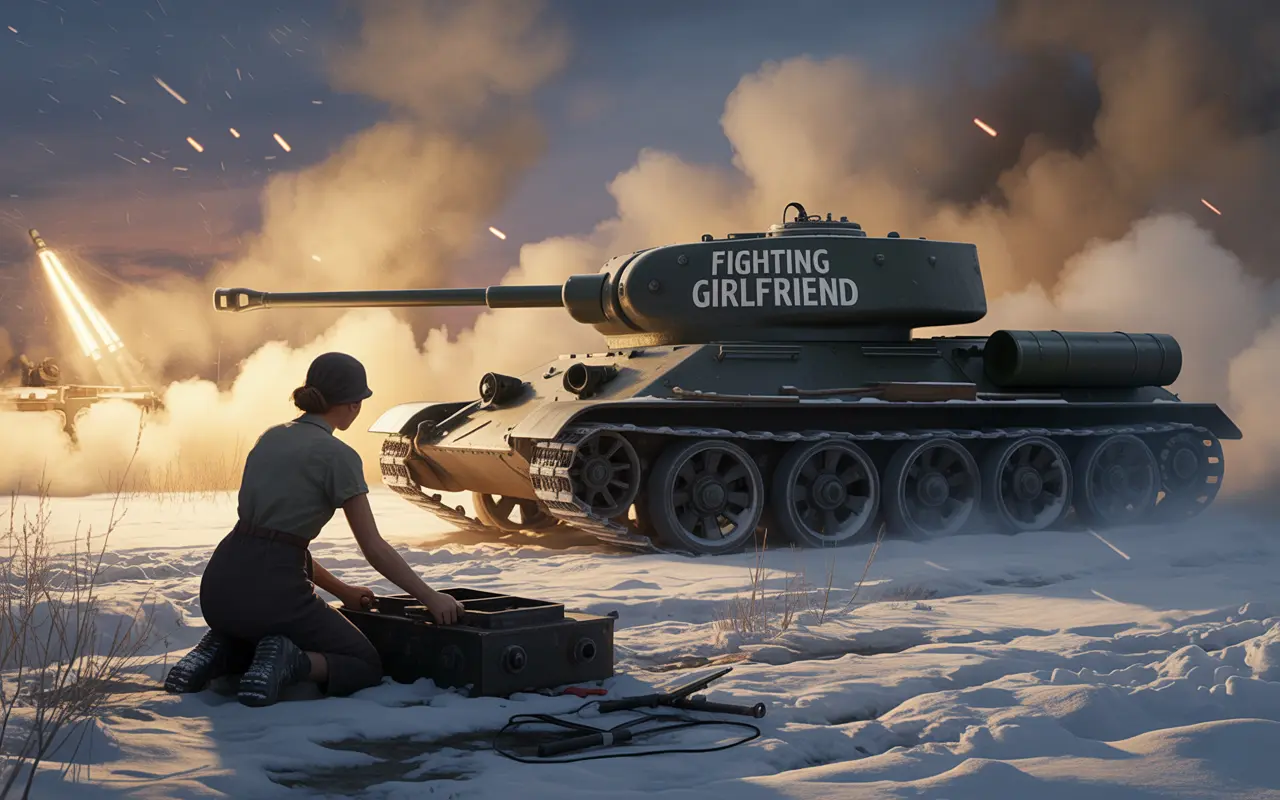
Mariya named it Боевая подруга — “Fighting Girlfriend.”
Becoming a Tank Driver — Against All Expectations
At 37, most women were expected to care for households, not command tanks. But Mariya entered the Omsk Tank Training School, where instructors were skeptical and some even laughed. A woman tank driver? A widow seeking revenge? It sounded like a dramatic fantasy.
But Mariya trained with a ferocity that silenced every doubt.
She mastered the engine.
She learned repairs, gunnery, and battlefield tactics.
She pushed herself harder than recruits half her age.
Soon, she was not “the widow.”
She was a tank driver—and a good one.
Her crew, initially hesitant about serving with a woman, quickly saw her courage. She was calm under fire, precise with her movements, and relentless in repairs. A tank is only as strong as the person who keeps it running, and Mariya treated Fighting Girlfriend like a living companion.
Into the Fire — And Earning Respect
Her first mission came in the Smolensk region in October 1943. As the battle raged, Mariya pushed her tank forward through artillery fire.
A German anti-tank gun struck the side of her T-34, damaging the tracks. Most tank crews would retreat and wait for mechanics.
Mariya did not.
Under heavy fire, she jumped out of the tank, tools in hand, and repaired it herself—while shells burst around her. Her crew screamed for her to get back inside. She ignored them. The tank mattered. The mission mattered. Her husband’s memory mattered.
She repaired the track.
She climbed back inside.
And she drove straight back into battle.
Her superiors took notice.
Her fellow soldiers began calling her not “the woman in a tank,” but “Sister of Victory.”
Battlefield Courage That Inspired a Nation
On another mission, her tank broke through German defensive positions and destroyed machine gun nests, artillery placements, and transport vehicles. Mariya maneuvered the T-34 with precision, giving Soviet infantry a chance to advance.
Again, the tank was damaged.
Again, Mariya leaped out into gunfire to repair it.
What made her so fearless? Grief, yes. But also duty. And a deep, burning belief that her life had meaning only if it was used to protect others.
Her bravery earned her the Order of the Patriotic War, and newspapers across the USSR told her story. It was a symbol: women could be heroes too.
But Mariya never cared about fame.
She cared only about the mission.
The Final Battle of the ‘Fighting Girlfriend’
In January 1944, during the battle near Vitebsk, Mariya again pushed her tank forward against fierce German resistance. The Fighting Girlfriend destroyed several enemy positions—but then came a devastating hit.
The tank was damaged.
Smoke filled the cabin.
Her crew shouted for retreat.
Mariya—once again—got out to repair the damage.
But this time, a mortar shell exploded nearby.
She collapsed, severely wounded.
Her crew dragged her to safety, but the injury was catastrophic. She fell into a coma and never woke up.
She died on March 15, 1944.
Three months later, she became the first female tank driver to be awarded the Hero of the Soviet Union, the nation’s highest honor.
A Legacy Written in Steel and Fire
Mariya Oktyabrskaya’s story is more than war.
It is about a woman who turned grief into action.
About love that endured beyond death.
About a widow who refused to let the world forget the name of the man she loved—and who discovered her own power in the process.
Her tank, the Fighting Girlfriend, became a symbol of defiance.
Her courage inspired a generation.
And her legacy remains one of the most extraordinary acts of personal vengeance, patriotism, and bravery in modern history.