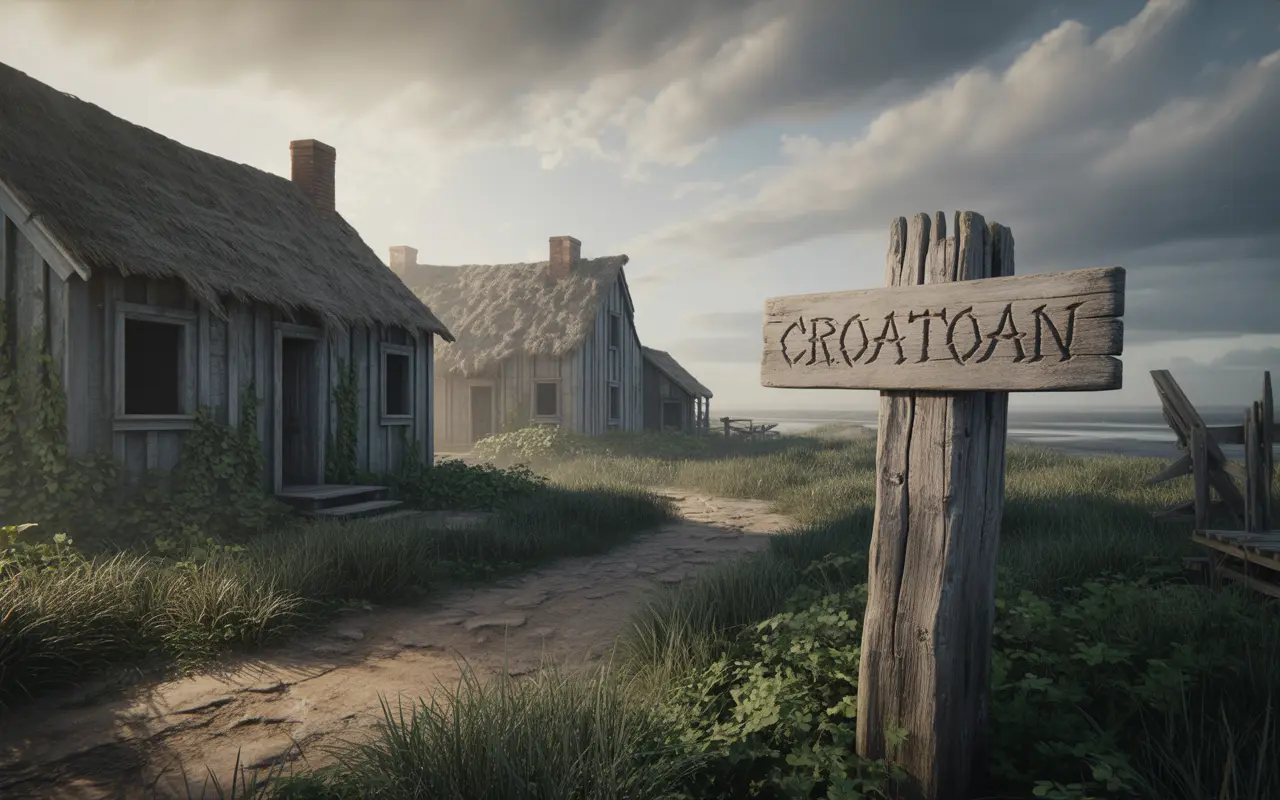
On the windswept shores of the Outer Banks of modern-day North Carolina lies a place where the Atlantic roars endlessly against shifting dunes, a place where gulls scream above the surf and the ground itself seems to whisper old secrets. Today, visitors walk those beaches with sunscreen and cameras, unaware that beneath their feet lies one of the most haunting mysteries in American history — the fate of the Lost Colony of Roanoke.
It is a story of hope and desperation, idealism and human fragility, promises broken and choices made in fear. It is a story that begins with optimism — and ends with a single carved word, left behind like a cry into the void: CROATOAN.
A Dream of a New World
In the late 1580s, England was hungry for glory. Spain dominated the seas, its ships overflowing with gold from the New World, and Queen Elizabeth I desperately wanted a foothold of her own across the ocean. Explorers, merchants, dreamers — all were caught up in a vision of opportunity.
Among them was Sir Walter Raleigh, a charismatic aristocrat with a mind full of ambition. Raleigh never set foot in North America himself, but he financed voyages, persuaded investors, and promised the crown that he would establish a successful English presence.
Roanoke Island became the chosen place — a narrow stretch of land bordered by marshes, wild forests and the ever-changing sea. It was beautiful, yes, but also isolated and unforgiving.
Still, in 1587, 117 colonists — men, women, and children — boarded ships with a mix of fear and courage in their hearts. They were ordinary people who dreamed of owning land, finding prosperity, or simply starting over. Among them were craftsmen, tailors, farmers, and several families traveling together. For many, it was a once-in-a-lifetime gamble.
And at their head was John White, an artist, a thoughtful observer, and the man appointed governor of the new colony.
White brought with him his pregnant daughter, Eleanor Dare, and her husband, Ananias. In a few weeks, Eleanor would give birth to the first English child born on American soil. Her name would become famous: Virginia Dare.
The colony’s beginning should have felt like the dawn of something grand, something historic. But from the moment their ships dropped anchor, the settlers felt the cold breath of uncertainty.
A Land Both Beautiful and Unforgiving
Roanoke greeted the colonists with towering forests, tangled thickets, and a humidity that clung to their skin like a second layer. The nights were dark, thick with the calls of unknown animals. Some found it thrilling — others terrifying.
The local Indigenous communities had complicated histories with the English. Earlier expeditions had led to violence, misunderstandings, and broken trust. Help was offered by some groups, suspicion by others. Food was scarce. Resources were limited.
But the colonists tried to hope.
They built houses, repaired old fortifications from previous expeditions, and began planting what they could. They explored cautiously, seeking places to fish and hunt. And beneath the hardships, families tried to create a sense of normal life.
On August 18, 1587, Eleanor Dare gave birth to Virginia, and for a moment the colony felt almost joyful — like a community worth fighting for.
But Roanoke was not a place that welcomed dreams easily.
Supplies dwindled. Weather became harsher. Conflicts with nearby tribes increased. The colonists begged John White to return to England for help.
White resisted leaving his family — resisted abandoning his newborn granddaughter — but finally agreed. He promised he would come back swiftly.
He could never have imagined that he wouldn’t set eyes on Roanoke again for three long years.
War, Delay, and a Long Silence
When White reached England, he found the country in chaos. Spain was preparing the Spanish Armada, and every ship was needed for war. No vessel could risk crossing the Atlantic.
John White pleaded, begged, even tried to sneak onto smaller ships, but storms, politics, and danger constantly blocked him. Months turned into years. His letters home haunted him. Did his family blame him? Were they waiting? Were they even alive?
Not knowing became a form of torture.
It was not until August 1590 that White finally secured passage and returned to the shores of Roanoke — desperate, hopeful, certain that any moment he would see smoke rising from chimneys or hear a child cry out.
But the island was eerily silent.
The Carving in the Wood
When White stepped onto the sandy shore, he found the fort dismantled. Houses collapsed. Gardens overrun. There were no bodies — no signs of violence — just a settlement abandoned with strange, deliberate tidiness.
What struck White most was the absence of fear. There were no signs of panic or sudden flight. Instead, belongings appeared organized or removed entirely. It looked as if the colonists had simply walked away.
White’s heart pounded. He followed every trail, scanned every tree, tried to breathe through the rising terror that his family had vanished into thin air.
Then he saw it.
Carved deep into a wooden post was one single word:
CROATOAN
And on a nearby tree, the letters:
CRO
White froze.
It wasn’t a random word. Croatoan was the name of a nearby island (today called Hatteras Island), home to a friendly Indigenous tribe with whom the colonists previously had good relations. The colonists had agreed that if they ever needed to relocate, they would carve a message indicating where they went. If they were in danger, they would add a cross.
No cross was found.
To White, it meant one thing: They had moved willingly.
His heart swelled with relief.
But nature had other plans.
A storm approached, fierce and sudden. The seas grew violent. The ship’s captain refused to risk further attempts to reach Croatoan. John White begged, cried, even promised part of his own pay — but the captain would not relent.
White was forced back to England.
He would never learn what became of his daughter, his son-in-law, or his granddaughter.
Theories, Whispers, and the Weight of Time
For more than four centuries, historians, archaeologists, storytellers, and skeptics have tried to uncover the truth of Roanoke’s disappearance. Theories stretch across a vast spectrum — some logical, some fantastical, some chilling.
1. Assimilation with Indigenous Tribes
Many researchers believe the colonists joined the Croatoan people or other local tribes, blending into their communities to survive. Stories of fair-haired Native children appeared in later records — tantalizing hints, but never proof.
2. Starvation or Disease
Harsh winters, lack of supplies, and isolation may have pushed the colony beyond endurance, forcing migration or leading to a quiet demise.
3. Conflict and Misunderstandings
Some suspect the settlers may have faced hostility from tribes who saw them as invaders — but no remains have been found.
4. A Split Colony
Some historians theorize the settlers divided — some going to Croatoan, others attempting to return north or inland. This might explain why no single site holds answers.
5. The Outlandish Theories
From alien abduction to supernatural curses to demonic winds — Roanoke has inspired centuries of folklore, each more bizarre than the last. But beneath all the wild tales lies a very human tragedy: a colony cut off from the world, left waiting for help that never came.
A Mystery That Refuses to End
What makes Roanoke so haunting is not simply that people vanished — but that they vanished without a trace of fear, leaving behind a single word that feels both promising and heartbreaking.
Were they alive when John White arrived?
Did they look out from the trees as his ship sailed past, unable to reach him?
Did Virginia Dare grow up speaking a different language, wearing different clothes, never knowing her birthplace would become legend?
We do not know.
But Roanoke lingers in the imagination because it reminds us of how fragile human plans can be — and how easily entire lives can vanish from history.
It is silence wrapped in salt air.
A question carved in wood.
A colony lost, but never forgotten.