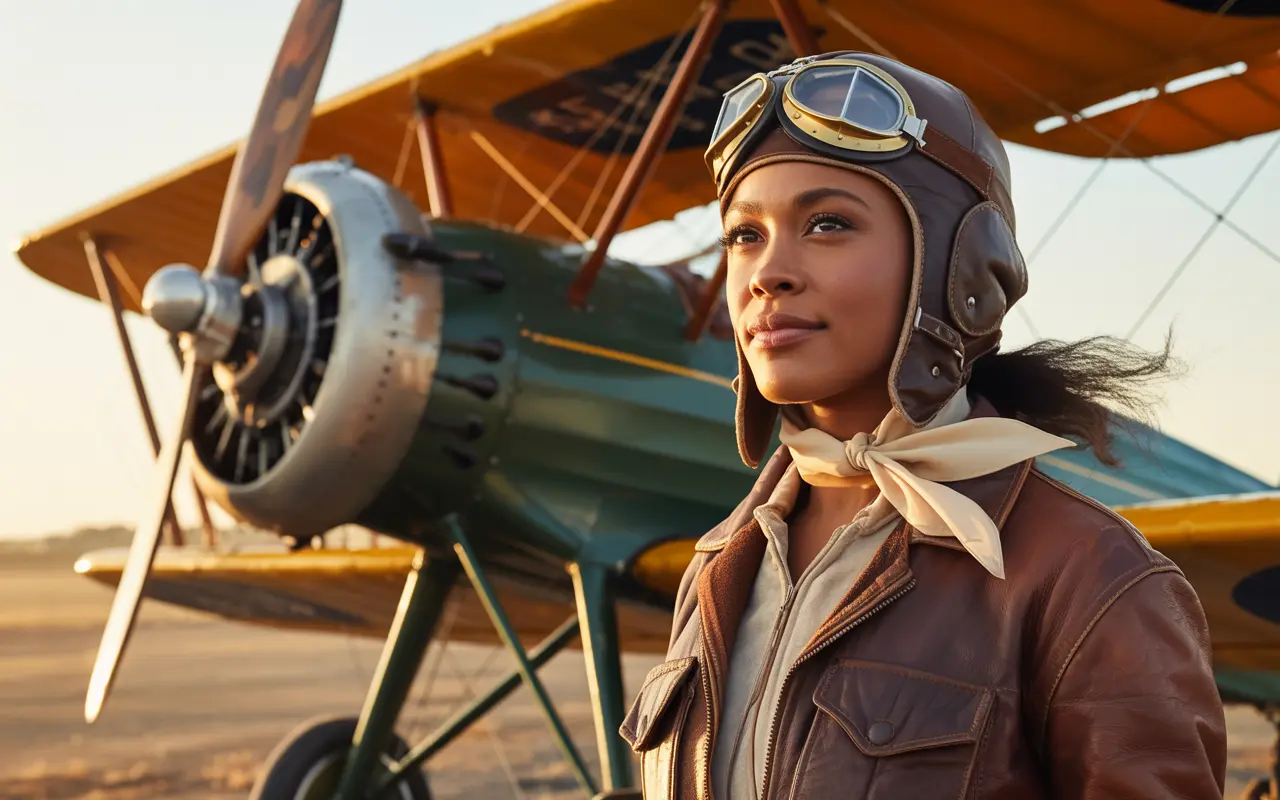
Bessie Coleman was born in 1892 in a small wooden cabin in Atlanta, Texas—one of thirteen children in a family that had to fight for every scrap of stability. Her childhood was shaped by hardship, long days, and the heavy, ever-present shadow of racial inequality. Yet even as a little girl, Bessie carried within her a force the world could not tame: a fierce and stubborn certainty that life had to be bigger than the cotton fields that surrounded her.
Her mother, Susan, was a woman worn by labor but unbreakable in spirit. She taught her children something essential: “You may be poor, but you are not small.” Her father, George, a man of Cherokee and African American heritage, dreamed of carving out a freer life for them in Oklahoma Territory. But when Bessie was just a child, he left—unable to endure the limitations imposed on Black families in the segregated South. His departure wounded her deeply, a wound that never closed.
By the age of six, Bessie was already picking cotton alongside her siblings. She walked miles each day just to reach the segregated schoolhouse, where a single teacher taught multiple grades and textbooks were tattered hand-me-downs. But she devoured every page, every number, every idea. Even as exhaustion tugged at her eyelids at night, she dreamed of something brighter.
When she was older, Bessie moved to Chicago, joining two of her brothers who worked in the stockyards. The city was loud, dirty, overwhelming—and alive with possibility. During World War I, her brother John, stationed in France, returned with stories of women pilots. Female aviators. Sky queens.
Bessie’s heart clutched at the idea.
Women flying.
Black women flying.
Could such a thing even exist?
In America, the answer was a devastating no.
Flight schools refused her instantly.
“You’re a woman.”
“You’re colored.”
“No.”
But rejection only sharpened her resolve. If the doors in America were locked, she would find another way in.
With the help of a powerful ally—Robert Abbott, the influential founder of The Chicago Defender—Bessie began learning French at night while working as a manicurist by day. Abbott encouraged her to pursue her dreams in Europe, where aviation schools were far more progressive.
In 1920, carrying money she had saved dollar by dollar, and with the fragile hope of a better world in her suitcase, Bessie boarded a ship for France.
She had never been on a plane.
And she barely spoke the language.
But courage like hers makes its own path.
The Caudron Brothers’ flying school in Le Crotoy accepted her. Training was brutal. The planes were unstable, deadly machines—canvas-covered wings and roaring engines that could, at any moment, betray their pilots. She learned to take off in unpredictable winds, to control spins, to land on rough fields. She crashed more than once. Each time she rose from the wreckage, dust in her hair, determination in her eyes.
On June 15, 1921, Bessie Coleman earned her pilot’s license from the Fédération Aéronautique Internationale.
The first Black female pilot in the world.
The first Native American woman to fly.
And one of the first American women of any race to hold an international license.
When she sailed back to the United States, crowds waited to greet her—crowds that had once dismissed her as impossible. Newspapers called her “Queen Bess,” “Brave Bessie,” and “The Girl Who Dared to Dream.”
But even with her license, opportunities were scarce. Flight schools still refused her. Aviation companies turned her away.
So she reinvented herself.
If she couldn’t fly commercially, she would fly for the crowds—barnstorming, the dangerous, thrilling world of air shows. She learned stunt flying in Europe, where she trained with top pilots who respected her talent. In 1922, she made her debut in the United States with a breathtaking performance in New York: loop-the-loops, figure-eights, steep dives—all orchestrated with skill and grace that left thousands speechless.
America adored her.
But fame never softened her fire.
She refused to perform at venues that banned Black people.
She refused to appear at segregated shows unless everyone—Black, white, and otherwise—was allowed through the same gate.
She used her voice relentlessly, speaking at churches, community centers, and Black newspapers, encouraging young African Americans to pursue aviation.
Her dream was not merely to fly—
she wanted to open a flying school for Black pilots.
But the skies that had carried her so high were also dangerous.
On April 30, 1926, while preparing for a performance in Jacksonville, Florida, Bessie climbed into the passenger seat of a plane piloted by her mechanic. She wanted to scout the site for a parachute jump that was part of the show. The plane malfunctioned mid-air. It spiraled.
Bessie, who was not strapped in so she could observe the field below, was thrown from the open cockpit.
She fell 2,000 feet.
The sky that had once sheltered her now let her go.
She died instantly at the age of 34.
Her dream of opening a flight school was unfinished.
Her life was far too short.
But the impact she made—impossible to measure.
After her death, Black aviators across the country banded together, forming flying clubs in her honor: The Bessie Coleman Aero Clubs. Decades later, her legacy would inspire the first African American military pilots, the Tuskegee Airmen. She became a beacon, a symbol, a blueprint for generations of pilots who soared because she proved the sky belonged to everyone.
Today, runways, scholarships, and aviation programs bear her name.
Books tell her story.
Pilots of every background call her a hero.
NASA honored her.
The U.S. Postal Service immortalized her in a stamp.
And every year, pilots perform flyovers at her grave in Chicago.
What Bessie left behind was more than history.
She left a message—one spoken not in words but in the wind beneath her wings:
“No dream is too high. No barrier is too strong. And no one has the right to tell you the sky is not yours.”