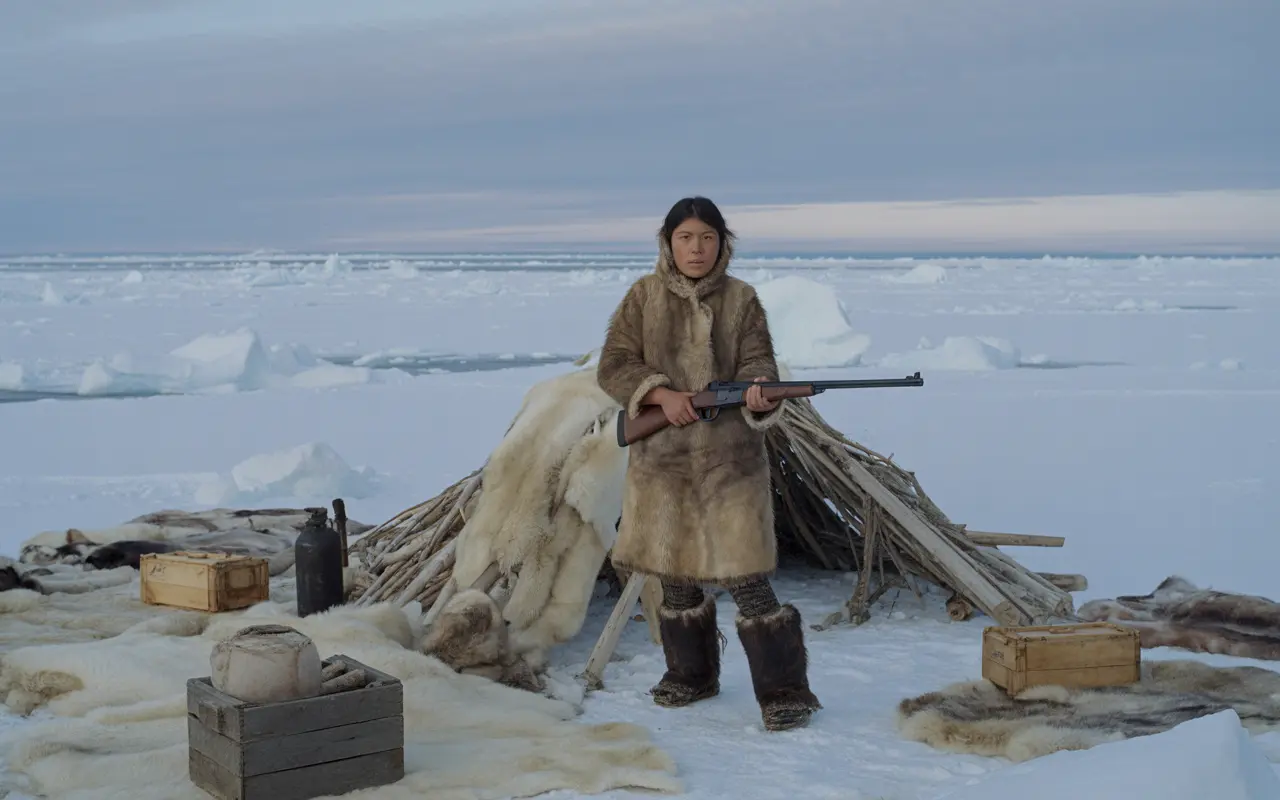
In the endless white silence of the Arctic, where the sun can disappear for months and the wind cuts like broken glass, a young Inuit woman named Ada Blackjack found herself utterly, terrifyingly alone.
No rescue party.
No shelter beyond what she could build.
No companionship except a cat named Vic.
And no reason to believe anyone would return for her.
Yet Ada survived.
Her story is one of the most extraordinary tales of endurance ever recorded—one often overshadowed by the men who led the doomed expedition, rather than the woman who actually lived through it.
To understand the depth of her courage, we must begin long before she set foot on Wrangel Island.
A Quiet Beginning
Ada Delutuk was born in 1898 in a small settlement in western Alaska, into a world vastly different from that of the Arctic explorers who would later depend on her. Life was harsh, but not unkind; she learned the quiet lessons of the North—how to read snow drift patterns, how to respect the sea ice, how to move through the world with humility.
But Ada’s early life wasn’t easy.
Her father died of influenza when she was a child.
Her mother, unable to provide for all her children, sent Ada to a mission school where she learned English, sewing, and Bible scripture—but little about survival skills traditionally passed from Inuit parents to their daughters. Despite being indigenous to the Arctic, Ada did not grow up hunting or trapping. That would become one of the cruelest ironies of her future.
At 16, she married.
At 18, she had a son—Bennett—born with severe health complications.
At 20, she was abandoned by her husband.
By the time Ada reached her early twenties, she was a single mother with no income, no support, and a desperately ill child. She needed money, and she needed it fast.
So when four men preparing for an expedition to Wrangel Island—a place known for unforgiving cold, treacherous ice, and deadly isolation—offered her work as a seamstress and cook, she agreed.
She didn’t want adventure.
She wanted to save her son.
The Wrangel Island Expedition
The expedition was led by Allan Crawford, a 20-year-old Canadian with leadership aspirations but no Arctic experience. Alongside him were Fred Maurer, Milton Galle, and Lorne Knight. All were young, eager, and painfully unprepared.
They boarded a small boat in September 1921, carrying with them:
- optimism
- rifles
- a few sled dogs
- and far too little food
Ada had been promised the expedition would last six months.
It lasted two years.
The moment they arrived, it became clear that Wrangel Island was not the untouched Arctic paradise they imagined—it was a place that demanded sacrifices from anyone who dared to stay.
The Slow Fall Into Disaster
At first, life on the island seemed almost manageable. They built a camp, hunted seals, and wrote in their journals about future fame.
But by the first winter, the food supply dwindled.
Storms raged.
The sea ice refused to cooperate.
The men began to argue—small disputes about chores turned into shouting matches. Tempers shortened as hunger deepened. The dogs grew thin. The men thinner.
And through it all, Ada worked silently.
She cooked what little there was.
She mended torn clothes.
She prayed.
She nursed the sick.
What no one expected was that the strongest person in the camp would be the one who felt the smallest.
Illness and Fear
By January 1923, the situation had become dire. Their supplies were nearly gone. Frostbite, scurvy, and starvation took hold. The men, desperate, planned a risky journey across the frozen Chukchi Sea to seek help.
But Lorne Knight—ill with scurvy and fever—was too sick to travel. As the others prepared to leave, Knight begged Ada not to let him die alone. So while the three men set off across the ice, Ada stayed behind as caretaker.
It was a decision that would define her life.
The three men disappeared into the Arctic wilderness.
No one ever saw them again.
Alone With a Dying Man
Now, Ada was alone with Knight—who grew weaker every day. He was demanding, angry, and often cruel. Some historians describe him as tormenting her emotionally; others say he was delirious and frightened. The truth is likely somewhere in between.
Ada kept him alive for as long as she could:
- cooking tiny meals from scraps
- boiling water from melted snow
- lifting his frail body to change his bedding
- sewing constantly to keep them warm
- reading scripture aloud when the darkness pressed too heavily on them both
But in June 1923, after months of suffering, Knight died.
And Ada—the young woman who had never hunted, never trapped, never camped alone—not only buried him but did the unthinkable.
She learned to survive.
Ada vs. the Arctic
The moment Knight died, Ada’s transformation began.
She wrote later that she cried for two days straight—terrified, exhausted, and certain she would not live to see rescue.
But then she stood up.
And she fought.
Ada built an improvised shelter using driftwood, canvas, and anything she could salvage. She constructed a makeshift gun rest so she could shoot accurately despite her small hands. She learned to set traps and check them daily. She hunted seals with a calm, steady patience that even experienced hunters struggle to maintain.
She kept a journal—not just to track her survival, but to keep her sanity.
Her entries reveal the emotional truth of her struggle:
“I am all alone. I am afraid. I think the white men will not come back.”
“I must try to be brave. If I don’t, I will die.”
“I do not want to die.”
She sang hymns into the empty air.
She read her Bible by the flickering seal-oil lamp.
She stitched clothing with numb fingers and hunted in blinding snow.
And she talked to her cat, Vic—the only living soul who listened.
For two months, Ada Blackjack survived alone on Wrangel Island.
No one else lasted that long.
Rescue at Last
On August 19, 1923, a ship finally reached Wrangel Island.
The crew expected to find graves.
Instead, they found Ada.
She stepped out of her shelter—thin, frightened, but alive.
Captain Harold Noice, who led the rescue, wrote:
“She looked at us as if we were ghosts. Then she said in the softest voice, ‘I am very glad to see you.’ ”
Ada returned home a legend—but she rejected the fame. The newspapers twisted her story, turning her into a spectacle. Men who had never met her spoke on her behalf. Others tried to profit from her suffering.
Ada asked only for one thing:
Money to care for her son.
Life After the Island
With the small payment she finally received, she brought Bennett to a hospital in Seattle, where he received better care and lived into adulthood. Ada remarried, had another son, and later raised two orphaned girls. She lived a quiet, calm life—her story nearly forgotten except by historians and Arctic researchers.
But her survival remains one of the greatest feats of human endurance ever recorded.
The Truth of Ada Blackjack
Ada was not a trained hunter.
She was not a seasoned explorer.
She was not fearless.
She was a woman who faced one of the harshest environments on Earth with nothing but determination, love for her child, and a will to live that outmatched even the Arctic.
Her story is not just about survival—
it is about dignity, resilience, and the quiet strength that history often overlooks.